
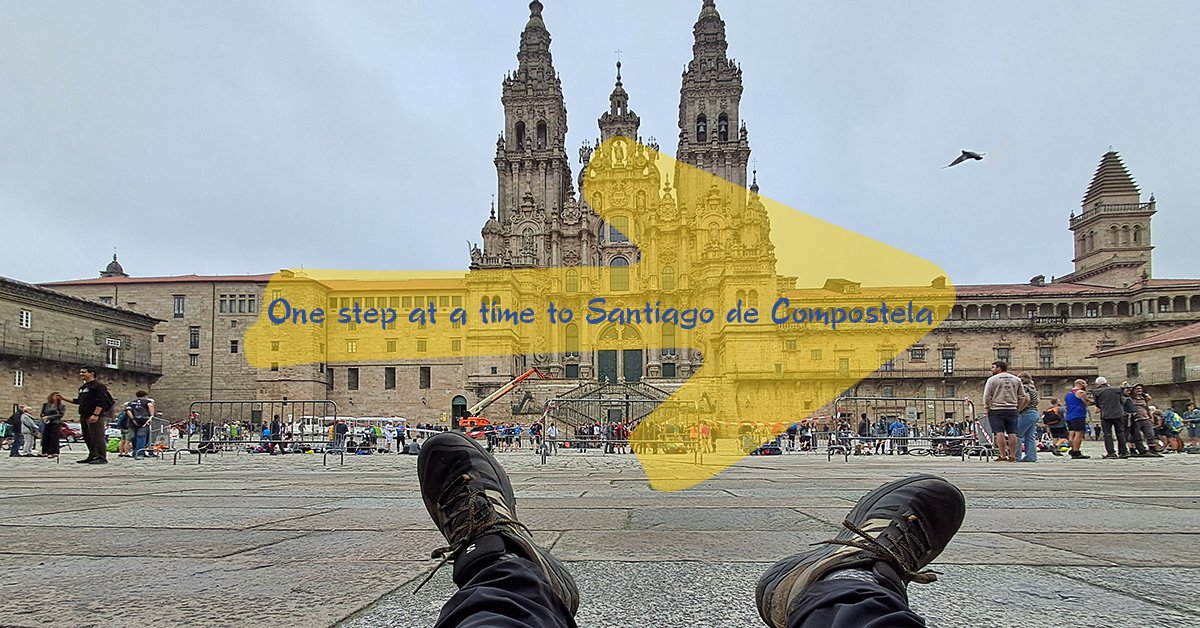
I decided to go on the Camino, although it wasn’t an easy decision, and to this day I’m not entirely sure how I ended up making it.
The first time I heard about the road to Santiago de Compostela was through a Facebook friend who was documenting her journey day by day. That was about ten years ago, and at the time it seemed like absolute madness to me. I mean, how do you walk hundreds of kilometres for dozens of days and sleep in hostels with complete strangers? What’s the point?
A few years later, the same person did it again, which only made me more confused. I simply couldn’t understand why anyone would willingly put themselves through such an experience.
Years passed, and eventually I reached a point in my life when I felt I needed to do something that mattered. I didn’t really know what that something was. But at some point, this thought started popping into my head: what if I walked the Camino too?
I quickly read a few articles to get an idea of what it involved, decided it wasn’t for me, and promptly abandoned the idea. I’m not really a hiker. At most, once every few years, I’ll do an easy mountain trail, and that’s about it.
What stuck with me from everything I read was the idea that, above all, the Camino de Santiago is a spiritual journey. People talked about finishing the Camino and having some kind of special experience, about something changing in their mind, body and soul. Beyond the physical challenge, the discomfort of walking day after day, the pain, and the prospect of sleeping in the same room with strangers, it was this idea of a spiritual journey that attracted me.
That phrase stayed somewhere in the back of my mind. I kept wondering what was actually waiting at the end of the journey, once you finally arrived in Santiago de Compostela.
Still, for a few months, the idea kept coming back. Every now and then, I would search for more information, just to satisfy my curiosity. And every time, I would eventually talk myself out of it. Yet somehow, the Camino continued to pull me back, even though I had absolutely no idea whether I could actually complete it.
I think about a year had passed since the first time the thought occurred to me. Then, completely at random, I was listening to a podcast when, at some point, the guest mentioned that he had walked the Camino.
It wasn’t even the subject of the podcast. He simply started talking about how he had walked hundreds of kilometres, slept with strangers in hostels, washed his clothes by hand every day, and everything else he had experienced along the way.
I took it as a sign.
That was when I decided I had to do it.
From that moment on, I started doing my research a little more seriously. I looked into how much money I would need, what equipment I needed, where I should start and which route I should take. I wrote down the bare minimum, decided I would walk the entire Camino Frances, and picked a start date.
I bought a one-way plane ticket to Biarritz, as it’s the closest airport to Saint-Jean-Pied-de-Port, the starting point of the Camino Francés.
Then I thought that, since I was going to get all the way to Biarritz, I might as well stay for two nights. You never know when I’d get another chance to visit, and the accommodation was booked anyway.
I chose a departure date towards the end of summer, hoping it wouldn’t be too hot. That left me with about two more months to wait, during which I had plenty of time to have doubts about the whole thing.
I still wasn’t convinced that I wanted to do it. And, more importantly, I wasn’t convinced that I actually could.
Time kept passing, the departure date was getting closer, and I had prepared practically nothing. So I rushed to Decathlon with my list and bought the bare minimum of what I thought I would need. I packed my backpack and waited for the day to come.
As departure approached, I kept thinking about giving up.
I kept telling myself that I couldn’t do this, that I would simply go to Biarritz, stay the two nights I had already paid for, and then go back home.
In the end, I went.
But I was nowhere near convinced that I was actually going to walk the Camino. If anything, I was still leaning more towards giving up.
What I Packed in My Backpack for the Camino de Santiago
Choosing what to take with me on the Camino was a bit difficult. It was my first time, after all, and I had no idea what I would actually need and what I could happily live without. Everywhere I looked, the same piece of advice kept coming up: pack light.
And honestly, it really is the most important advice of all. The problem is that “just the essentials” have a funny way of adding up.
I tried to think logically about what clothes I would need for walking, what I would need at the albergue, what I would sleep in, and what other accessories and necessities I might need along the way. I didn’t exactly go overboard with the packing, but in the end I still had about 7 kg to carry on my back, all packed into a 40-litre backpack.
For the journey
For walking, I took two changes of clothes, because you never know. In reality, if you wash them early enough, they have plenty of time to dry and you can easily wear them again the next day.
I’m a fan of long trousers and long-sleeved shirts, partly because they protect you from the sun and partly because they offer some protection from the occasional scratch from vegetation along the trail.
So, for walking, I took:
- 2 long-sleeved merino wool shirts
- 2 pairs of long trousers
- 1 pair of thick-soled Salomon shoes
- 2 pairs of merino wool socks
- 1 hat
- 1 pair of sunglasses
- 1 waterproof jacket
- 1-litre reusable water bottle
For staying at the albergue
Since the clothes I wore during the day would be washed, I figured I should have something else to change into for the rest of the day, whether I was hanging around the albergue or walking around a town.
For this, I packed:
- 1 pair of long trousers
- 1 hoodie
- 2 T-shirts
- 1 pair of lighter shoes
- 2 pairs of thinner socks
- 1 pair of slippers
- about 5 pairs of underwear
For sleeping I took:
- 2 T-shirts
- 2 pairs of shorts
- 1 fitted sheet that I could wrap myself in
For hygiene and other things
I kept this part pretty basic:
- Towel
- Toothbrush and toothpaste
- 2 soaps – one for washing clothes and one for my body
- Plasters
- Anti-inflammatory medication
- Phone and charger, obviously
So I didn’t take that much with me. At least, that’s what I told myself.
But as I said, all those “not that much” items still add up. And every single one of them was going to sit on my back every day, for hundreds of kilometers.
The Two Nights I Spent in Biarritz
The day of departure finally came, and I set off. I was hoping for a new beginning and, perhaps, that spiritual revelation everyone kept talking about.
I hadn’t even managed to sleep the night before the flight, probably because of the adrenaline and everything that was waiting for me. I had a layover on the way to Biarritz, and the whole journey took around eight hours. Luckily, I managed to doze off a little during the flights.
When I arrived, I walked to my accommodation. I wasn’t sure whether there were buses, and I didn’t want to spend money on a taxi. After all, I was a pilgrim traveling on a tight budget.
I had booked the accommodation through Airbnb and was staying with an older lady who was very kind. She didn’t speak a word of English, and although I knew some French, I hadn’t actually used it in years, so expressing myself was quite a struggle. We managed to communicate with the French I could still remember, with a little help from Google Translate when necessary. We didn’t interact all that much, but somehow we managed.
The room was rustic and very chic. I had a shower and a sink in the room, but the downside was that there was only one toilet. I figured I could survive for two nights.
Once I arrived, I couldn’t resist going out for a little walk. I wanted to find something to eat, have a drink and get my first look at the town. I was exhausted, but curiosity won.
The next morning, I set off early to explore Biarritz. I walked until my eyes practically popped out. I walked the entire cliff from north to south, then from south to north. I stopped at all the beachside bodegas and watched the surfers.
I would have liked to take a dip in the Atlantic, but for some reason I hadn’t brought any swimming shorts. I noticed that some people were swimming naked, but I didn’t dare do the same. I was tempted, admittedly, but I didn’t have the courage. I kept looking for some designated or more secluded spot where I could do it without making a complete spectacle of myself, but there wasn’t one. And so I missed the opportunity.
I hesitated, and eventually I just kept the idea in my head. I think it would have made for a memorable memory.
I didn’t eat much that day, just an overpriced beach wrap and some pastries. Biarritz is quite an expensive resort, and I was trying to stick to my budget. I still had many days ahead of me.
I walked along the beach until almost evening and managed to get a bit sunburned in the process. I hadn’t even taken my hat with me, let alone put on any sunscreen. Clearly, I was already showing some promise as a long-distance pilgrim.
After walking all day, I eventually reached the point where I felt I simply couldn’t walk anymore. Luckily, I found a bus that took me close to my accommodation.
I slept soundly that night and looked forward to finally starting the journey to Santiago de Compostela.
Strangely enough, I hadn’t even had time to think about it.
My 800 km Journey in 33 Days on the Camino Frances to Santiago de Compostela
I kept a diary throughout the Camino, documenting each day of the journey as it happened. So rather than just giving you a summary of the route, I wanted to share the whole experience. The long days, sore feet, unexpected encounters, small discoveries, frustrations, good meals, and all the moments in between. This is what my 33 days and 800 km on the Camino de Santiago actually looked like.
Day 0: Biarritz – Saint-Jean-Pied-de-Port
I woke up in the morning and walked to Biarritz train station to catch the train to Saint-Jean-Pied-de-Port. The plan was to start walking as soon as I arrived. My train was at 11:30, and about an hour later, I arrived in Saint-Jean.
As soon as I got to the station, I saw a lot of pilgrims and decided to hurry to the registration office so I wouldn’t have to wait in line for too long. I ran over to get my credentials (my Camino passport) only to discover that, of course, we were in France, and the office was closed from 12 to 2 pm.
At that point, I decided it would be better to spend the night there. Starting the first stage that late didn’t seem very realistic. The problem was that there was almost nothing available.
To make matters worse, I didn’t even have internet to look for a place to stay on Booking or Airbnb. I stopped at several restaurants and terraces, hoping to connect to their Wi-Fi, but either there wasn’t any or they didn’t want to give me the password.
Eventually, after quite a bit of searching, I found a restaurant with Wi-Fi and sat down for a drink while trying to find somewhere to sleep. The internet connection was painfully slow, and this wasn’t exactly an expense I had planned for, but after some struggling I managed to find a nice room right in the center.
Once that was sorted, I finally relaxed and went back to stand in line to register and get my Camino passport.
I washed the clothes I had worn over the previous few days, which turned out to be a terrible idea, weather-wise. I got about an hour of sunshine, and then it started raining heavily. The clothes didn’t dry at all, and I had to struggle with them afterwards.
I went out for a walk around town, but because it was Saturday, almost everything was closed. The market was closed too. It shuts at eight, and by the time I got there, I couldn’t find much of anything open.
So I settled for a drink on a terrace and then headed back to my accommodation, thinking about the long journey I had ahead of me.
Day 1: Saint-Jean-Pied-de-Port – Roncesvalles – Espinal (30.8 km)
I left at around 10 am, even though I had been awake since about 8. I was waiting, hoping the sun would come out and dry my clothes, but no such luck. It appeared for a few minutes, then disappeared again, and it didn’t help at all. So I left with my clothes still wet, hanging some of them from my backpack in the hope that the sun might catch them along the way.
I had treated this day pretty casually because, honestly, I had no idea what to expect.
I started the climb from an altitude of roughly 300–400 meters. The road through the Pyrenees is paved, but that doesn’t make it easy. You just go up, up and up.
I ate my first sandwich and got my first stamp, at Orisson. It was only about 10 km in, and I was already exhausted.
The climb was extremely steep and much harder than I expected. I took countless breaks because I simply hadn’t imagined it would be this difficult right from the start. At one of the stops, I found a water fountain and filled up my bottle. That’s where I met Laura from Hawaii, the first person I spoke to on the Camino.
Along the way, I saw beautiful landscapes and passed herds of cows, sheep and horses. On this side, it was mostly pasture, with very few trees. I kept going, sweating and tired. For most of the time it was sunny, but at one point I suddenly found myself in thick fog and started worrying that I might catch a cold.
As long as I kept moving, though, I didn’t feel cold at all, even with my shirt completely soaked in sweat.
I sweated and dried myself off about four times. I got tired and turned back about five times. I wanted to give up about ten times.
I had already encountered a much harder route than I had anticipated.
What the fuck am I doing this for?! No one was forcing me to do this. I kept repeating that to myself all the way up.
But I kept going anyway.
The difference in altitude was huge. At one point, I reached around 1,400 metres after starting at roughly 400 metres. Even though much of the route is on a paved road, covering that distance while gaining that much elevation is no joke.
I pulled myself together and kept going. I found another fountain, filled up with water, caught my breath and moved on.
After all that climbing, the road finally started going downhill, cutting through a forest. Going downhill felt like flying.
I checked Google Maps and realised I had already crossed into Spain. I had expected some kind of border guard or checkpoint. There was nothing. Apparently, I had just walked into another country without anyone particularly interested in stopping me.
Anyway, I carried on.
The road descended through the forest, which was incredibly damp and covered in thick fog. The whole landscape was quite spooky, but I was happy because I was getting closer to my destination and, more importantly, there was no more climbing.
Although going down wasn’t exactly easy either.
After the foggy forest, I came across a terrible valley. The descent was extremely steep, full of rocks and moisture. I honestly hadn’t expected the downhill section to be harder than the climb.
I pushed on, watching Google Maps and seeing that I was getting closer to my destination. In my excitement that I didn’t have much farther to go, and because I was walking pretty fast, I almost slipped on a wet stone. Luckily, I managed to catch my balance immediately.
Eventually, I approached my destination with hunger in my throat and the satisfying thought that I was about to successfully complete my first stage.
I wasn’t sure what to do first: eat or find somewhere to sleep. I decided to go to the albergue first and figure out the rest afterwards.
Big surprise!
The only albergue in Roncesvalles, with its 150 beds, was completely full.
Shock. Shock. Shock.
A million thoughts went through my mind at once.
Where am I going to sleep?
I’m going home! Fuck this! I don’t need to do this.
I tried to calm myself down on a terrace while looking for solutions. I thought I’d get a hotel room, but there was nothing available there either. Even though it wasn’t exactly budget-friendly, I was prepared to do that too.
I’m sleeping on the street, I told myself.
I’m going home! Fuck this!!!
Luckily, the guys at the albergue gave me the names of other hostels in the surrounding villages. I had the complete list, but I hadn’t even considered the possibility that I might have to walk even farther.
I called the first one, which was 3 km away. No answer.
The second one, 6.5 km away, said they had beds available.
It was already 7:30 pm, so I set off towards Espinal.
I almost ran there.
I have no idea where I found the energy. I had already been exhausted for hours and was convinced I was dying, yet somehow I still managed to cover those last kilometers.
I arrived around 9 pm, washed up, got into bed and felt genuinely grateful just to have somewhere to sleep.
I also hung up the clothes that were still wet. They hadn’t had enough time to dry. I didn’t wash the clothes I was wearing because it was damp outside, and I had another change of clothes ready for the next day anyway.
It had been an extremely hard and challenging day. Much harder than I had anticipated.
And it was pretty clear that if I had known beforehand what I was going to go through, I would have left much earlier.
Still, I was glad I had made it to the end.
I just hoped this would be the hardest day of the entire Camino.
I got a top bunk, which meant this was also my first ever experience staying in a hostel.
There was snoring during the night.
But I was so exhausted that I didn’t even care.
Day 2: Espinal – Zubiri (15 km)
The fact that I had done those extra 6+ km the day before helped a little, because today’s stage was shorter. I was using the dedicated Camino apps and following the stages they had laid out. It was actually more convenient that way, since the suggested stops were usually in larger towns where you had more albergue options. It made sense to stick to the preset stages.
Even though it was a shorter route, it was still quite hard. There was a long climb followed by a steep descent, and I spent most of the day walking around like a zombie, wondering what exactly I was trying to achieve with this hike.
I didn’t even take a single photo.
At that point, all I wanted was for the day to be over.
I arrived in Zubiri relatively early, completely exhausted, and tried to resist going to bed too early. The town was small and there wasn’t much to do, so I sat on a terrace for about two hours, where I had something to eat and drink.
I stayed at a fairly large municipal albergue with several rooms, although there were only six or eight beds in each room. I met an American named James from Dallas, Texas, and a younger American woman named Dana. I also noticed a few Italians who weren’t stayed too much in our room, as well as a Spaniard, Señor Pedro, who didn’t speak a word of English.
At one point, Señor Pedro asked me for some rolling papers, but he didn’t spend much time in the room either.
If the previous night I had only caught a few snores, tonight I was treated to the most terrible snoring I have ever heard.
I fell asleep around 9 or 10 pm. Later, Pedro, who was sleeping in the bunk below me, came in and started snoring heavily. And he didn’t stop.
After every snore, he would have some kind of spasm that shook the entire bed, which would then creak the bed as well.
It was terrible.
Still, I was so tired that I somehow managed to sleep, although my sleep was constantly interrupted because I could hear and feel him all night.
As if that wasn’t enough, a group of Italians cooked in the evening and stayed in the kitchen, talking until late. Eventually they got drunk and started partying until around 1 or 2 am. They sang, shouted and talked loudly in the corridors, creating absolute chaos.
Then, just before 5 am, Pedro suddenly got out of bed, still snoring, farted and quickly left the room.
Not long after that, at 5 am, an alarm went off on someone’s phone.
Loudly.
Someone got up and apparently hit snooze. The Italian guy said it wasn’t his.
The alarm went off a second time, and this time Dana got out of bed and hit snooze again.
It rang a third time.
This time, the Texan tried to turn it off, but I got down from my bunk and managed to switch it off completely. It was an Android phone, and I guess they weren’t used to it.
Somehow, James seemed annoyed with me, as if it had been my alarm going off.
It hadn’t. I only had my phone on vibrate, and it was right there with me in bed.
By then it was already past 5 am, and after everything that had happened during the night, I couldn’t get back to sleep anyway.
I had managed to get at least some sleep, so I got up and went outside.
Pedro was already there, holding a rolled cigarette in one hand and a bag of laundry in the other, hanging his clothes out to dry. He didn’t speak English, but I tried to explain that an alarm had gone off on someone’s phone.
He told me he didn’t have an alarm.
It wasn’t his.
Well, if I was already out of bed, there was no chance I was going back to sleep.
Day 3: Zubiri – Pamplona (20.4 km)
Because I had woken up so early, I spent about two hours in the kitchen, drinking a few coffees, having an orange juice and getting a sandwich from the vending machine.
At one point, the fairly spacious kitchen filled up with pilgrims. They were all very determined to leave early, heading out into the dark at 6 or 7 am, even though it was cold and had started to rain a little.
I took my time. I waited for the sun to come up and, hopefully, for the rain to stop. Only then did I start getting ready to leave.
Today, I cursed the entire way.
I kept asking myself why the hell I was doing this and what I needed it for. After all, nobody was forcing me to do it.
At the same time, I really wanted to reach Pamplona early. It was the first proper city on the route, and I wanted to have enough time to explore it.
The trail was rough, with rocks and mud, and it was one continuous series of ups and downs. Completely exhausting.
I thought I had escaped the mountains, but most of the route was still through the woods. And, to make things even better, there wasn’t a single village along the way where I could stop for something to eat or drink.
So I swore my way through the entire day.
When I entered Pamplona, it started raining. For the first time, I actually needed the waterproof jacket and the cover for my backpack.
Not long after, I found a bar and stopped for a while to take shelter from the rain. I had a tuna sandwich and a drink. I ran into the Texan there, as well as an American I had exchanged a few words with on my first evening. We said hello, and then each went on with our own business.
It wasn’t long before the rain stopped.
I continued towards the centre and the albergue, and on the way it seemed as if all my fellow pilgrims suddenly appeared at once. We formed a long line and made our way towards the municipal albergue.
When I arrived, I got a little shock, but in a good way.
The Albergue Jesús y María was set up in a former cathedral, and we were all staying under the same roof. There were little four-bed cubicles, but essentially we were all breathing the same air.
I didn’t stay long. I took a shower and headed into town to explore.
It was around 3 pm, and the streets were surprisingly deserted. I still hadn’t got used to the Spanish schedule and their famous siesta. I stopped in the central square and had a burrito and a cheese pie. They were excellent and went straight to my heart.
After 5 pm, people started coming out and the streets gradually filled up.
I got talking to a local guy and we chatted for a while. I’m still not entirely sure how we managed to communicate, because he didn’t speak much English and my Spanish consisted mainly of Google Translate. Somehow, we had a good time anyway, and then I continued exploring.
I walked around almost continuously until about 9 pm, checking out every little street, as if I hadn’t already walked enough for one day, or as if I didn’t have to walk again the next morning.
I eventually got back to the albergue quite late, but surprisingly there were fewer snorers than I expected. Even though the place was full, and I noticed Pedro was there too, the night was actually pretty quiet.
Day 4: Pamplona – Puente la Reina (24 km)
I could barely get myself out of bed after all that walking, but I decided it had been worth it. I set off leisurely, without rushing, especially since the route looked fairly easy today, with no major climbs.
I stopped for a coffee but didn’t eat anything. I was still full from the day before.
Today I was in a much better mood. It felt like I was finally starting to stop worrying about all the difficulties. Whatever happened, I was going ahead.
Along the way, I had one small moment of hesitation and immediately regretted it. I passed an apple tree with a few apples lying on the ground. They looked really good, but I didn’t pick one up and eat it.
Later, when I came across something else, I didn’t hesitate at all.
I peeled a sunflower and cracked sunflower seeds as I walked. Twice.
There were also plenty of blackberry bushes along the route, and I stopped several times to eat the berries because they were big, ripe and practically begging to be eaten.
There were lots of vineyards in this area too, so I stopped to eat some grapes. I also picked three small walnuts and put them in my backpack for later.
Along the way, I stopped in a village and tried empanadas for the first time. They might have just become my new favourite food.
At one point, I came across an American-style food bus and had a very good cake from them. Very nice.
When I reached my destination, the €9 albergue was fully booked.
I found another one.
Also full.
Eventually, I found a larger albergue, Santiago Apostol, and luckily they had plenty of space.
I showered, made my bed, washed my clothes and went out for a walk.
The village was nice, but small, and there wasn’t much going on. I bought some more empanadas from the supermarket, but they didn’t come close to the ones I’d had in the restaurants.
Eventually, I went back to my room because I was exhausted.
Luckily, it wasn’t very crowded, and it was quiet.
Day 5: Puente la Reina – Estella (21.9 km)
I woke up and packed my things slowly, without rushing. I had a coffee and talked to a German guy who had slept outside in a tent.
He was also walking the Camino, but preferred to sleep in a tent most of the time. I thought the albergues were challenging enough, but compared with sleeping outside, especially with the cold nights and high humidity, they suddenly didn’t seem so bad.
Just as I was about to leave, the guy from the albergue gave me some anti-inflammatory gel, which was very welcome because my knees and feet were starting to hurt.
Until the first village, I’ve met Lucia from Canada and walked and talked with her. She was a very talkative and lovely pensioner. She walked surprisingly fast despite being quite small and a few years older.
I eventually lost her on a climb when she stopped to take off her jacket. I wanted to get there faster so I could eat something and have a coffee.
I stopped for an omelette and chorizo sandwich, plus coffee.
The route was mostly flat and relatively easy. In the next village, I spotted a ham-and-cheese croissant and immediately wanted one, so of course I had to have it.
There were several villages along the way to the destination, and I stopped in every single one.
I ate more sunflower seeds, blackberries, grapes and an apple along the way. Why not?
I arrived at the Albergue de Peregrinos de Estella around 3 pm, took a shower, washed my clothes, and around 5 pm I went out into the city to see what was happening.
I wandered around like crazy again, exploring all the little streets. When I finally felt exhausted enough, I headed back to my room.
The noisy group of Italians was in the kitchen again, making a big mess, but luckily they didn’t stay up too late this time.
The bedroom was very quiet.
My back had started to hurt a little from all the walking, probably from the backpack as well.
But it is what it is.
Day 6: Estella – Los Arcos (21.4 km)
It rained all night. It was absolutely bucketing down.
I had left my clothes hanging on the balcony of my room, but with all that humidity, they still hadn’t dried by morning.
As usual, I struggled to get out of bed. The fatigue and the aches were starting to catch up with me. It looked like the rain had finally stopped, so I packed slowly and left among the last ones.
Still, I put the cover on my backpack and put on my raincoat.
The moment I stepped outside, it started raining again.
This was the first proper rain I had experienced on the route, and it was absolutely relentless. I was cold, sleepy, my legs hurt like hell, and on top of everything else, I was getting soaked.
After about an hour, I stopped for a chocolate pastry and a coffee. The rain stopped almost immediately, and I started feeling optimistic about the weather.
The moment I finished my coffee, it started again.
And this time it rained heavily for another hour or so.
Luckily, I was well protected, but it was still thoroughly uncomfortable. The trail was full of puddles, slush and mud, making everything even harder.
Along the way, I ran into Lucia and Laura again. I had met Laura during the first couple of days, although I hadn’t even asked her name, or maybe I had and simply forgotten. They recognised me and greeted me.
I was standing in front of a winery when they told me they had wine on tap. Free for pilgrims.
One tap with wine, one tap with water.
Now, it was still quite early in the morning for wine, but I was cold and thought a little drink might warm me up. Unfortunately, I had nothing to put it in. I had just finished a bottle of water at the café and thrown it away.
My only option seemed to be taking a cardboard cup from the rubbish bin and washing it under the tap. And I in that matter I could drink easily.
I didn’t really want to empty my water container and fill it with wine because I was already running low on water.
It was only much later that I realised how ridiculously simple the solution was.
I could have emptied the water, drunk as much wine as I wanted, and then simply refilled the bottle from the water tap sitting right next to it.
I still don’t understand why my brain refused to make that connection at the time.
The only solution I could think of then was to fill the entire 1-litre bottle with wine and use that as my source of hydration for the day.
It seemed slightly inappropriate for a pilgrimage.
I still regret that moment.
I stopped in the next village and had another coffee, a slice of anchovy pizza and a bread roll with some vegetables.
Along the way, I ate blackberries, grapes and a peach. I regretted not taking more peaches, because although they were still a little unripe, they tasted good.
Around noon, the sun finally came out and it got warm, although the trail was still muddy. Luckily, most of the route was relatively flat and paved with gravel.
When I arrived in Los Arcos, I couldn’t get a bed at the municipal albergue, which cost €8, but I found a place in another one for €12 (Albergue La Fuente Casa de Austria).
I went through the usual routine, showered, washed my clothes and then went out for a leisurely walk around the village.
It was quite small, so I had pretty much finished exploring it in no time.
At one point, I was in the central square when I noticed the doors of the church opening. People were starting to go inside to visit, so I took the opportunity to have a look as well. It was impressive, both in size and in the way the interior was designed. For such a small village, the church was remarkably imposing.
The only real option for food was a restaurant with a terrace right in the central square, where most of the pilgrims had gathered. I had soup and paella.
I also tried sangria for the first time. It cost €3 a glass, but I wasn’t particularly impressed.
What did impress me was how much red wine everyone else was ordering. The bottles kept coming, one after another. Normally, I had been drinking one beer a night, with a glass costing somewhere between €3 and €5. This time, seeing everyone drinking red wine, I decided I should try a glass too.
I was pleasantly surprised when they charged me only €1.60 for a glass and it was very tasty. So I ordered another one.
I ended up spending quite a while on the terrace because the atmosphere was lovely, with pilgrims from all over the world sitting around, talking and sharing stories.
Eventually, I headed back to my room. The next day I had almost 30 km to walk, according to what I had seen, and I was heading to a slightly larger town that was worth exploring.
I even intended to leave a little earlier than usual in the morning. But we would see how I felt.
Day 7: Los Arcos – Logroño (27.9 km)
Today I have almost 28 km to walk, my first longer stage apart from the first day.
I could barely convince myself to leave because it was quite cold in the morning. There was nowhere to get a coffee because nothing was open yet, but I found a vending machine and got myself a Coke.
The bad part was that the first village was quite far away, so it was going to be a long time before I got my first coffee.
Luckily, most of the route was flat. Around noon, the sun came out and things started to feel a little better. Even so, I was getting to the point where I could barely walk anymore. Up and down we went, but I kept moving.
The breaks in the villages helped, even though they were few and far between. At least I could stop, catch my breath and recover a little.
Along the way, I stopped at a place where a Dutchman had parked his camper van and was offering drinks to pilgrims on a donation basis. Quite a few people stopped there, and it had become a little gathering point where everyone stood around talking.
It was really hard. Especially towards the end, when I felt like my legs simply couldn’t hold me up anymore. With every step, I felt like I had nothing left.
Somehow, I made it.
I looked for the cheapest albergue, but it was full, so I found one right next door for €18 (Albergue Santiago Apostol). I knew it was supposed to cost €12, and honestly, it wasn’t worth €18. It seemed a bit dirty, with large rooms packed with pilgrims. But that was what was available.
On top of that, everyone was keeping their hiking boots next to their beds. It was the first time I had seen that. Everywhere else, boots had been left at the entrance.
Still, I was grateful once again simply to have somewhere to sleep.
In the big room, I ran into my now-familiar Camino friends: Laura from Hawaii, Jamie from Texas and Dana.
I didn’t stay long in the room because I wanted to explore the city.
Even when I’m completely exhausted, every time I arrive in a city I somehow find the energy to go exploring. The truth is, once I take the backpack off and there’s no pressure to get anywhere, it’s as if my strength comes back. Suddenly I have enough energy to walk around the city again.
The streets were much as I had become used to by now: narrow lanes and elegant houses.
In the evening, the streets filled with people.
I had been looking for something to eat for a while when I spotted a restaurant called Bueno Bueno. Judging by the name, it seemed pretty clear that I was going to find something good there. Maybe it would even be reasonably priced.
I ordered two tuna empanadas and two ham-and-cheese croquetas. The croquetas were served warm, with the cheese melted inside. It really was Bueno Bueno and cheap too. I ate well, and because I liked the croquetas so much, I ordered two more and enjoyed them just as much as the first ones.
I kept wandering through the streets, which were now full of cheerful, well-dressed people of all ages.
At one point, I stopped in the central square next to the church. There was a huge murmur coming from all the conversations happening at once, with people sitting around and talking.
There was an incredible energy in the place.
I didn’t even want to leave.
I stayed until 10 pm, then went straight back to my room and into bed, grateful that it was so close.
Day 8: Logroño – Nájera (29.4 km)
Today was another long day.
I had coffee at the albergue and left around 8 am because I was too lazy to get up earlier. I just didn’t feel like it. Every morning I was getting more and more tired, and my legs were starting to hurt more and more.
On my way out of town, I came across an open pastry shop and had a few pastries that I really enjoyed.
I carried on, although I no longer had quite the same enthusiasm. My knees were hurting like hell, but I kept going. It was cold too, and the sky looked like it was about to open up.
In the first village, I ran into Lucia, Dana and Laura. We all sat down for a while, talked, had a snack and enjoyed another coffee. I had already walked 10 km by then, so I considered it a well-earned reward.
Not long afterwards, the rain started.
Much of the route was cold, windy and cloudy. The sun eventually came out, but quite late and not for long. Before reaching the second village, it got cold and rainy again.
Eventually, the sun came back out and things seemed to improve. My legs were sore and I had to drag myself along, but I kept going.
I caught up with Lucia again and walked alongside her to the next village. She had a great attitude, talked a lot and walked surprisingly fast for her age. Talking to her somehow lifted my spirits, and I found a faster, more comfortable pace. I felt good walking with her, but at some point she stopped in a smaller village while I still had about 10 km to go.
I eventually made it, but for a while I honestly thought the road would never end.
Those 29 km seemed to go on forever. Hard. Hard, hard, hard. Luckily, most of the route was flat, but I still struggled.
As expected, the cheap €6 albergue was full when I arrived around 5 pm. The noisy group of Italians were already there too, so I had to keep looking.
The next place I found cost €15 and had the last available bed (Albergue Las Peñas).
There were several albergues in Najera anyway, although they were smaller ones. By that point I was so exhausted that I didn’t even feel like looking for another option. It wasn’t particularly expensive, and I was just happy to have found a bed.
There were only four beds in the room, which felt like absolute luxury on the Camino.
Obviously, after the usual routine (shower, wash clothes, make the bed) I went out to explore the town a little.
Najera was small but nice.
While walking around, I came across a bar that seemed to be for locals only. There was no sign at the entrance, and inside there were nothing but older people and no tourists. Everyone was dressed nicely, sitting around, playing cards and having a good time.
I ordered a glass of wine for €1.10.
It was good.
It was cheap.
So naturally, I ended up having a few glasses and spending about an hour there.
I asked the bartender what the card game was called and I understood “tute”, although I’m not completely sure.
Later, the ladies arrived, all elegant and heavily perfumed. They took over a separate table and started playing cards as well.
It was a great atmosphere, even though I understood almost nothing of what was being said in Spanish.
Luckily, I managed to get along with the gentleman behind the bar and successfully ordered my vino tinto.
That was enough for me.
Later, I stopped at a restaurant offering the pilgrim’s menu. For €14, I got bean stew, chicken breast with fries and caramel cream for dessert. They also brought me a large glass of wine.
Usually, in bars, they fill the glass about a third of the way, never more than half. Here it was almost full, maybe because it was included in the menu.
The food was delicious and I devoured it.
I also liked that the restaurant wasn’t very crowded and that the waitress was patient and kind with all my questions about the menu.
I got back to the room around 10 pm and went straight to bed.
Day 9: Najera – Santo Domingo de la Calzada (20.8 km)
Although there were only four of us in the room, at least two of them snored like crazy. One of them was just as loud as the Spaniard in Zubiri.
Luckily, I was so exhausted that I barely heard them.
It wasn’t even 6 am and everyone was already up. Alarms were going off, lights were being switched on, and nobody seemed particularly concerned about making noise while packing their bags.
At least I had the room to myself after everyone left, so I slept peacefully until around 7 am.
I didn’t feel like getting out of bed. My legs were hurting, and I just wanted to stay there. I opened the window slightly and felt the cool air outside.
Even packing my bag was a struggle. I had to summon whatever courage I had left to get moving because it was cold and my legs were aching.
Once again, I seemed to be the last one to leave. I could tell by the shoe rack. Mine were the only pair left.
As soon as I stepped outside the albergue, I spotted an open café and walked in without a second thought.
A double espresso and a bacon roll. I had just cheated breakfast for €2.
The route was mostly flat and I had around 20 km ahead of me. It looked like it was going to be an easy day.
And as soon as I started walking, it was almost as if I couldn’t feel my knee pain anymore. The gel I had been given earlier had clearly helped, because I had applied some before leaving.
In the first village, I stopped for another coffee and an omelette with potatoes.
I kept noticing how interesting it was that, on the Camino, you constantly run into people again. You meet someone, lose them somewhere along the way, and then suddenly see them again in another village. People who were strangers yesterday become familiar faces without either of you really planning it.
Before the penultimate village, after a hill I had to climb, I came across another donativo offering refreshments. I stopped for a little while to rest.
I had expected this to be an easy day. Then something happened that I can’t really tell you about, at least not in any detail. Let’s just say that, possibly because of the stew I had eaten the night before, my stomach suddenly decided it had other plans.
It was very serious! And the worst possible setting for it: an open field, full of pilgrims, with not even a bush to hide behind. It became a genuine challenge to make it to the first restaurant.
After that little adventure, I didn’t stop again until I reached the albergue. I found the biggest one I could, with a bed for €12 (Albergue de Peregrinos Cofradía del Santo).
I did my usual routine and then lay down for a while to rest. Good thing I did. My stomach trouble came back with a vengeance.
This time, I decided it was safe enough to go outside. The shops were still closed, but as I walked around I realised I wasn’t feeling particularly well.
I hadn’t gone very far when I turned around and hurried back to the albergue. I was definitely not okay.
Eventually, I went out again for a walk, although the streets were still mostly deserted.
I wandered through all the narrow streets and took some photos. I came across an open bar that was, unsurprisingly, completely empty. There was a woman sitting at the bar reading. Another young man, who seemed to work there, was watching television on a national channel. I ordered a glass of red wine for €1 and didn’t stay long before continuing my walk.
A little later, I came across another bar full of locals. They were playing cards outside, so naturally I went in. Inside, it was the same kind of atmosphere as the night before, just in a different town.
I sat at the bar and ordered another vino tinto. I wanted to absorb some of that local energy and recharge myself a little. There were three card tables inside and one outside.
An old man was reading that day’s newspapers at the bar next to me. At the other end, three men were chatting away happily.
I asked the bartender again what the card game was called. He barely understood what I was asking, but it sounded like it was called “chinchon”. There were probably several different games being played. I would have loved to know the rules. I definitely would have joined in.
I wandered around the streets for a little longer, but the town wasn’t very big and there wasn’t much left to see.
Eventually, I stopped near the albergue and found a restaurant where I could finally have the calamari and fries I had been craving for several days. The places I had originally wanted to eat at hadn’t had them available when I was there, so this was my chance.
I ate my fill and enjoyed the atmosphere too, with locals and pilgrims sitting together. As soon as I finished eating, my stomach started acting up again.
I quickly ran back to the albergue because I knew exactly what was waiting for me.
It was late anyway, so I got into bed.
The room was almost empty, even though the beds were occupied. I had no idea where all the other pilgrims were. There was a little noise coming from the dining room, but I closed the door and fell asleep almost immediately.
I don’t think it was even 10 pm.
An easy day in terms of distance, but terrible overall. I had been thinking that I was starting to get bored with the Camino. And then, on the easiest day so far, I had my most intense adventure yet.
Shitty day.
Purgative.
Day 10: Santo Domingo de la Calzada – Belorado (22.2 km)
I slept like a log. I woke up a few times during the night, but every time it was pitch-black and completely quiet. I didn’t hear a single snore.
I opened my eyes around 6 am and, surprisingly, there wasn’t even an alarm going off. For the first time, the albergue remained completely quiet until around 7 am.
Eventually, I got up and went through my morning routine. I had a coffee from the machine in the kitchen and got ready to leave. When I went back upstairs, I noticed an Italian with long hair in the room. I had met him on the road before.
I left around 8 am, but it didn’t really matter. I had about 22 km ahead of me and most of the route was flat.
As I started walking, I noticed that my feet no longer hurt, and my knees were only slightly sore. The first town was about 5 km away, and I got there fairly quickly.
Along the way, I kept picturing it in my mind some toast. From what I had heard, toast was supposed to be good for the stomach, and after yesterday’s little adventure, I was taking no chances.
At the entrance to the village, there was a food van with a long queue. I looked at the menu. They had tostadas. I joined the queue.
The service was painfully slow, and the queue barely moved. I waited for quite a while, but I was patient because, finally, I had found my toast.
I ordered two ham-and-cheese sandwiches and a coffee. I asked the señorita to toast them well. They were excellent.
I left fairly quickly because I had already spent enough time standing in line, and by then it was getting cold.
There were several villages along the route, quite close to one another. The first was only about 2 km away, so I stopped there for a short rest.
Another 2 km later, there was another village. I was hoping to find some more tostadas, but there was nothing. I didn’t stop and kept going.
For most of the way, I passed pig farms and cattle, and the smell was terrible. The fields were also being fertilised with cow dung, and there were tractors everywhere, ploughing the land. Apparently, I was still stuck in the same shitty movie today.
The weather had been cloudy and slightly cold so far, although I didn’t really feel the cold while walking. By around noon, the sun came out.
There were lots of open fields and almost no shade. It didn’t bother me, so I kept walking.
In the penultimate village, I came across a bar where I bought two bananas and a croissant. Apparently, bananas were good for the stomach too.
I sat there for a while and exchanged a few words with some gentlemen from different countries (American, Irish and German). A young man of about 20 also joined us. His father had apparently sent him on the Camino.
Eventually, I reached Belorado and went to the first albergue where I had originally planned to stay. It was a little outside the town centre, and the atmosphere seemed rather sad, so I decided to keep walking.
I found another one for €12 – Albergue Municipal Belorado El Corro.
Here, however, they asked me for an extra €1 for disposable sheets. They asked if I wanted them. Of course I wanted them. What else was I supposed to do? Everywhere else they had been free, but now I had to use them.
The albergue looked rustic, but the beds were terrible. The mattresses and pillows were covered in vinyl and looked extremely worn. Good thing I hadn’t tried to save that extra euro.
The room was almost empty. There were only two Spaniards getting ready for their siesta.
I did my usual routine (shower, wash clothes, make the bed) and not long afterwards, the American from the terrace and the 20-year-old kid showed up as well. They settled into the beds next to me. We exchanged a few words, and then I went back outside because I was bored and wanted to explore.
The town wasn’t very big. Within about half an hour, I had walked through pretty much every street.
On the terraces, I ran into several fellow pilgrims I had seen many times along the Camino. We greeted each other and exchanged a few impressions from the road.
I took a bottle of water back to my room and then went to a restaurant where I had noticed earlier that they offered a pilgrim’s menu for €14. It wasn’t crowded at all, probably because it was still early by Spanish standards. I was hungry, though. I had paella, vegetable lasagne, flan and wine. Muy bueno! Especially the wine, which came in a clay carafe. I poured myself a glass, then another, and possibly another one after that. I have to say, it was a pretty good deal.
Afterwards, I stayed in the central square for another wine. All the pilgrims I already knew were there, along with others I was seeing for the first time.
I stayed there until around 9 pm, then headed back to my room and went to sleep.